
NCERT Science often looks simpler than it is. The language is compact, examples seem ordinary and important reasoning may sit inside an activity, caption or single sentence. Students who read only to finish pages can miss the exact relationships an examination later tests.
To read like an examiner does not mean predicting questions. It means noticing what can be asked: a cause, comparison, condition, observation, diagram, equation, calculation, inference or application.
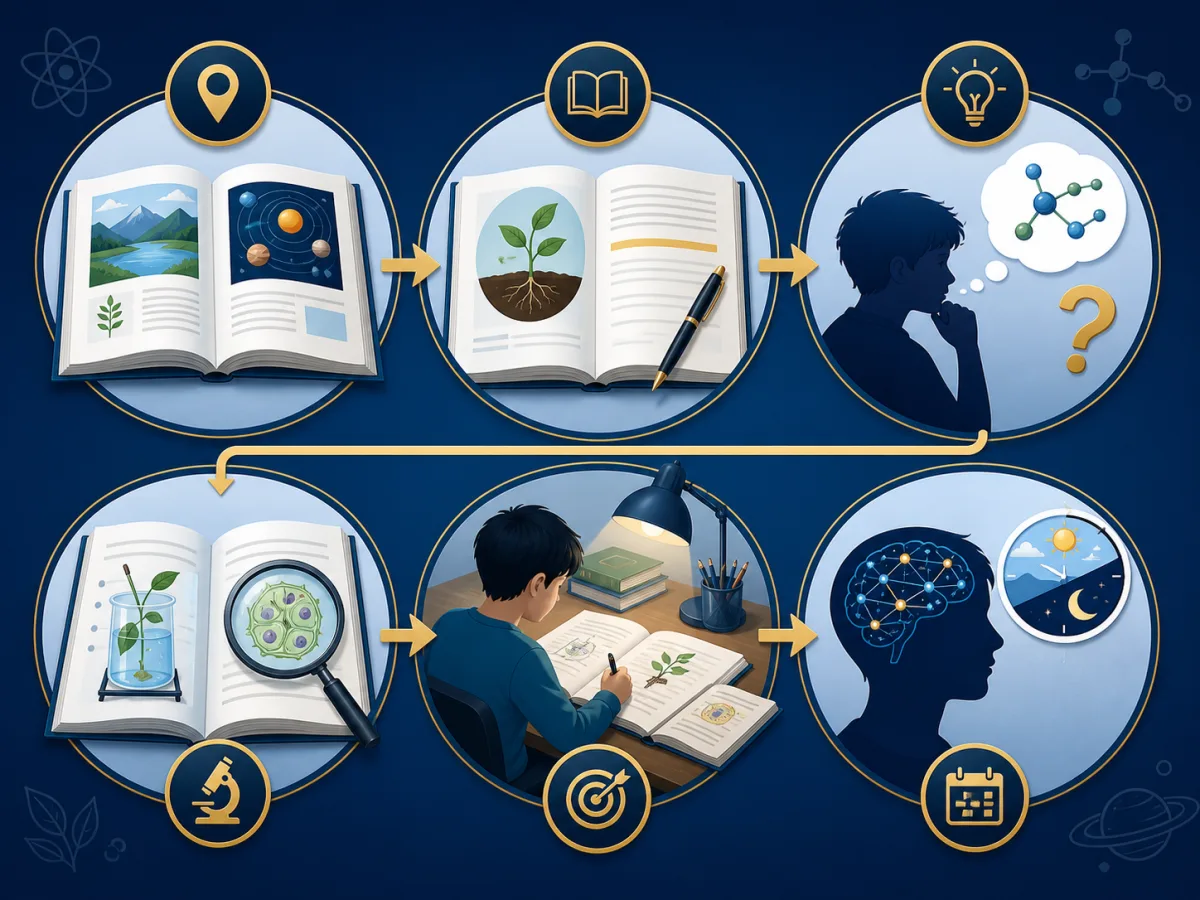
Use the current edition and current syllabus
Begin with the textbook edition prescribed for your session and your board’s official syllabus. Chapter arrangements and rationalised content can change. Avoid building a plan from an old guide’s chapter list. CBSE students should consult CBSE Academic; RBSE students should check the Board of Secondary Education Rajasthan resources.
The first pass: build the chapter map
Read headings, subheadings, opening questions, diagrams and summary. Do not memorise yet. Write five to ten questions the chapter appears to answer. This gives new details a structure.
The second pass: read in small reasoning units
After one or two paragraphs, pause and ask: what changed, why did it change, under which condition, and what evidence supports it? Close the book and explain. If explanation collapses, reopen only the relevant section.
| Textbook feature | What to extract | How it may be tested |
|---|---|---|
| Activity | Purpose, setup, observation, inference | Case, experiment or reason question |
| Diagram | Structure, labels, direction, function | Label, explain or predict |
| Equation/formula | Meaning, condition, unit and relationship | Balance, calculate or apply |
| Comparison | Shared basis and consequence | Differentiate or justify |
| Everyday example | Concept operating beneath context | Competency-based application |
Activities are not side stories
For each activity, create six prompts: What is being investigated? What material or condition matters? What is observed? What conclusion follows? Why does it follow? What would change if one condition changed? This turns procedure into scientific reasoning.
Study Chemistry as a connected system
Maintain a reaction record with reactants, products, balanced equation, type, required condition and visible observation. Link related reactions and ask what evidence distinguishes them. Never memorise formulae with incorrect symbols simply because a guide printed them.
Study Biology through structure and flow
Trace pathways and causal chains. Draw from memory. Explain how structure supports function. Definitions matter, but board answers often need relationships: how a process occurs, why regulation is needed, or what consequence follows a disruption.
Study Physics through meaning before substitution
For every formula, identify quantities, units, conditions and direction of change. Estimate whether an answer should rise or fall before calculating. Solve the textbook examples independently after understanding them.
Use in-text and exercise questions diagnostically
Attempt without looking at the nearby paragraph. If stuck, identify whether the problem is recall, concept, interpretation or expression. Correct the cause and retry later. Do not copy answers merely to complete the notebook.
Convert a chapter into a one-page reconstruction sheet
After understanding, include only the central map, formulas or reactions, must-draw diagrams, difficult comparisons, common errors and retrieval prompts. It should help rebuild the chapter during revision, not duplicate every sentence.
The examiner-style question ladder
- Can I define or state it?
- Can I explain why it happens?
- Can I compare it with a related idea?
- Can I interpret an activity or diagram?
- Can I apply it in a new context?
- Can I justify or predict an outcome?
If a concept survives all six levels, it is far more secure than one remembered only as a definition.
A complete chapter cycle
Map the chapter, read in small units, retrieve, study activities and visuals, solve textbook questions, attempt application items, log errors, and retest after a gap. Use official sample papers and marking schemes for paper style, while remembering that no resource can guarantee exact questions.
Before reading: ask what you already know
Write three to five ideas from memory before opening a chapter. This activates prior knowledge and reveals misconceptions. After reading, return to the list: correct it, connect it and add what was missing. The contrast makes learning visible.
How to annotate without covering the page
Use a small consistent code: a question mark for doubt, an arrow for cause-effect, a box for a required term, and a short margin question for retrieval. Avoid marking every sentence. If everything is important, the markings cannot guide attention later.
Read captions, examples and questions as part of the text
A diagram caption may specify direction, condition or function. An everyday example may become the basis of an application question. An opening question often frames the reasoning that follows. Skipping these pieces creates gaps even when the main paragraphs are read.
How to unpack one dense paragraph
- Identify the subject: what process or object is discussed?
- Circle the change or relationship.
- Find the condition under which it is true.
- Restate it in simple accurate language.
- Create one question and one example.
- Check that simplification did not change the Science.
Reading Chapter 1 as a model
In Chemical Reactions and Equations, do not collect equations as disconnected lines. Link each activity to reactants, conditions, observable evidence, balanced representation and reaction type. Compare why two reactions belong to different categories. Explain oxidation and reduction through what changes, not only memorised labels.
Reading Life Processes as a model
Build flows for nutrition, respiration, transport and excretion. For every organ or structure, connect feature to function. Redraw pathways and explain where materials enter, change, move and leave. Compare plants and animals on matching functions rather than memorising two separate essays.
Reading Electricity as a model
Do not jump from formula to formula. Begin with current, potential difference and resistance as relationships. Interpret circuit diagrams, understand series and parallel conditions, track units and solve examples independently. Ask what stays constant and what changes in each arrangement.
Reading Our Environment as a model
Trace matter and energy through food chains. Distinguish biodegradable and non-biodegradable effects with reasoning. Use diagrams to explain trophic levels, and avoid adding unsupported slogans where a scientific consequence is requested.
How to verify a doubt responsibly
Return first to the relevant textbook section and classroom notes. Then consult current official curriculum resources or ask a teacher. Online summaries may use old chapter sequences, different board content or oversimplified claims. Record the resolved doubt in your own words with its source.
From NCERT paragraph to board-ready answer
After understanding, identify the likely command: state, explain, compare, calculate or justify. Extract the required scientific points, then write without copying the paragraph’s entire wording. Check terms, sequence and any diagram or equation. This protects accuracy while building independent expression.
Use exemplars and question banks after the foundation
Application resources are valuable after the relevant concept is secure. Attempt first, check reasoning and record the error type. Do not judge preparedness by the number of PDFs downloaded. A small set studied deeply is better evidence.
A seven-session chapter plan
| Session | Outcome |
|---|---|
| 1 | Prior knowledge and chapter map |
| 2 | First half understood and retrieved |
| 3 | Second half understood and retrieved |
| 4 | Activities, diagrams, equations or numericals |
| 5 | In-text and exercise questions |
| 6 | Application set and error correction |
| 7 | Delayed chapter test and revision sheet |
Common traps while using guidebooks
Guidebooks may be useful for extra questions, but check whether the edition and syllabus match. Avoid absolute claims such as “every board question comes from this list.” Never copy an answer whose equation, terminology or chapter context conflicts with the prescribed source.
How much time should one chapter take?
There is no honest universal number. Length, prior knowledge and question difficulty differ. Set outcomes and test them. A chapter is not complete because a timer ended; nor should perfection on one difficult paragraph stop all progress.
Revision after the first complete reading
Return with closed-book questions rather than another full reading. Use the chapter map, diagrams, reaction or formula list and previous errors. Reopen the textbook selectively where retrieval shows a gap. Later, mix the chapter with related topics.
The textbook becomes powerful when you stop treating it as pages to finish and start treating it as reasoning to reconstruct.
Frequently asked questions
Should I memorise NCERT line by line?
No. Learn precise terms and required facts, but understand relationships and practise expressing them accurately.
Can reference books replace NCERT?
They can add practice, but should not displace the prescribed textbook and official board resources.
How many readings are needed?
Count successful learning cycles, not readings. One focused reading followed by retrieval and testing can outperform repeated passive reading.