
Falling behind rarely happens in one dramatic moment. It begins quietly: a chapter understood only halfway, two assignments copied because there was no time, a test avoided because the score might hurt, and a promise to “cover everything on Sunday.” Then one evening a student opens the books and feels that every subject is asking for attention at once.
If that is where you are, the first truth is important: feeling behind is not proof that you cannot recover. It is proof that your work has become undefined. The mind is frightened by a large, shapeless problem. Recovery begins when that problem is converted into a small number of visible decisions.
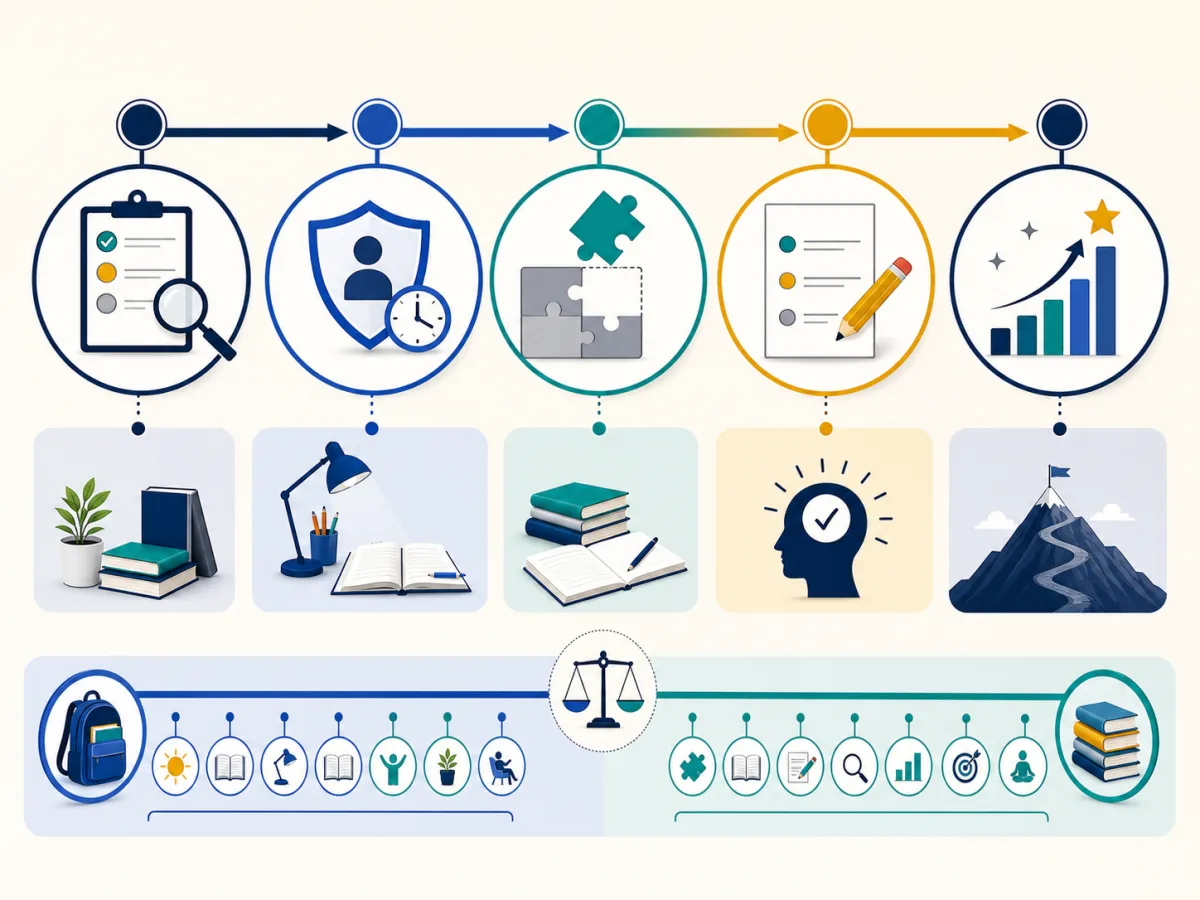
You do not need to become a different person overnight. You need a system that still works on an ordinary Tuesday when motivation is low.
First separate facts from fear
“My whole syllabus is incomplete” may feel true, but it is rarely a useful diagnosis. Take the official syllabus and classify every chapter as secure, partial, untouched or tested but weak. Secure means you can answer questions without the book. Partial means the lesson looks familiar but recall is unreliable. Untouched is self-explanatory. Tested but weak means a checked paper has already shown a specific problem.
Now attach evidence. Write “cannot balance equations” instead of “Chemistry weak”; “forget the steps after factorisation” instead of “bad at Maths”; “know the history chapter but answers lack points” instead of “SST impossible.” The moment a fear receives a name, it can receive a study task.
| Vague worry | Useful diagnosis | Next action |
|---|---|---|
| I remember nothing | I cannot recall without seeing the page | Close-book retrieval after each section |
| Maths is too hard | I make sign errors in linear equations | Ten targeted questions plus an error check |
| I have no time | Two hours disappear between phone use and deciding | Preselect the first task and use a timed block |
Use two tracks, not one rescue marathon
A common mistake is stopping current schoolwork to “finish the backlog.” After ten days the old backlog is smaller but current chapters have become a new one. Every weekday therefore needs two tracks: keep pace with what is being taught now, and repair one older gap.
A realistic school-day structure could be 60–75 minutes for current work, 40–50 minutes for one backlog unit, 20 minutes for recall, and a short language or formula review. These are examples, not laws. A student with travel, household responsibilities or coaching may use smaller blocks. The non-negotiable idea is continuity between present work and repair work.
Choose backlog by consequence, not guilt
The oldest chapter is not automatically the first priority. Give priority to a chapter if it supports later learning, appears frequently in assessment, is included in the next school test, or can be repaired quickly enough to unlock confidence. In Science, weak balancing and reaction concepts damage later Chemistry work. In Mathematics, gaps in algebraic manipulation spread across chapters. In languages, writing practice improves through repetition, so it should not be postponed until the end.
What “complete a chapter” should actually mean
Watching a lecture is exposure, not completion. Copying notes is storage, not mastery. Use a five-stage cycle:
- Understand: read the prescribed text or learn the concept with full attention.
- Retrieve: close the source and explain the idea in your own words.
- Apply: solve representative questions without copying the method.
- Correct: identify why each wrong answer occurred.
- Return: test the chapter again after a gap.
A chapter moves from backlog to secure only when you can retrieve and apply it. This definition prevents false progress—the comforting feeling of having “done” many chapters that disappear during a test.
A seven-day recovery cycle
Day 1: audit chapters and select one recovery target. Days 2–3: learn its core concepts and solve basic questions. Day 4: attempt questions without notes and record errors. Day 5: repair the weakest subtopic. Day 6: take a short timed test. Day 7: review the test, revisit earlier material and select the next target.
This cycle looks modest because it is designed to finish. Students who feel behind often create plans for their most energetic imaginary self. A useful plan must fit the real student who attends school, gets tired, has difficult days and still needs sleep.
Recover subject by subject
Science
Separate concept, language and application. Build reaction tables in Chemistry, redraw Biology diagrams from memory and solve Physics numericals with units and meaning—not formula substitution alone. Use the current NCERT text as the primary anchor and check your board’s prescribed syllabus before adding extra material.
Mathematics
Begin with solved examples only long enough to understand the method, then work independently. Label errors as concept, procedure, calculation or interpretation. Re-solve wrong questions after two days without seeing the solution.
Social Science
Turn headings into questions, build timelines and cause-effect chains, and practise maps regularly. One chapter recalled in structured points is worth more than three chapters highlighted beautifully.
Languages
Keep them alive through short frequent contact: reading, vocabulary in context, grammar correction and one timed written response. Expression improves through use, not last-week memorisation.
When shame is consuming study time
Some students spend the first twenty minutes of every session remembering what they should have done earlier. That emotion may be understandable, but it cannot complete today’s work. Replace self-judgment with a written starting ritual: put the phone away, write the exact finish line, set a manageable timer and begin with the first visible step.
Comparison is equally expensive. You see a classmate’s completed notebook, not the quality of their recall; their confident sentence, not their private confusion. Your best comparison is between last week’s evidence and this week’s evidence: chapters tested, errors corrected, questions completed and recall improved.
What to do after a broken day
Do not punish one missed session with an impossible next day. Divide tasks into essential, useful and optional. Carry forward only the essential task, keep current work protected and restart. A recovery system is judged not by never breaking, but by how cheaply it restarts.
Design a timetable around energy, not fantasy
Not every hour has the same value. If you concentrate best soon after returning from school and resting, use that period for a difficult concept. Keep lower-energy time for vocabulary, diagrams, map labels or organising the next session. A plan that gives the hardest task to the hour when you are most exhausted will look excellent on paper and repeatedly fail in life.
Use finish lines rather than subject names. “Study Science for one hour” leaves room for indecision. “Read the section on oxidation, explain it without the book and solve questions 1–5” tells you what success means. Before ending the day, write tomorrow’s first task so the next session does not begin with twenty minutes of choosing.
How to use teachers, classmates and online lessons
Help works best when the doubt is specific. Instead of saying “I understand nothing,” show the exact step where the reasoning breaks. Ask why a particular equation balances that way, why a theorem applies, or why an answer needs another point. A precise doubt is easier to teach and easier to remember.
Do not let online lessons create another backlog. Select a lesson to solve a named problem, pause to attempt examples, and finish with independent questions. Watching several teachers explain the same chapter can become avoidance disguised as research.
A recovery plan for students with very little daily time
If only 60–90 minutes are available, protect three actions: current work, one small repair and retrieval. For example, spend 35 minutes understanding today’s lesson, 30 minutes repairing one backlog subtopic and 10 minutes recalling yesterday’s work. Use longer weekly blocks for tests and chapters that need continuity.
Small blocks must still contain depth. Ten focused questions corrected honestly are more useful than forty rushed questions. Two pages explained from memory are more useful than a chapter skimmed while distracted. Limited time makes prioritisation more important, not recovery impossible.
How parents can support recovery
A student already worried about backlog does not need a daily reminder that time was lost. Parents can help by asking for the week’s concrete plan, protecting a reasonable study space, noticing completed cycles and contacting a teacher when the student cannot diagnose a gap. Comparison with relatives or classmates may create movement for a day but often damages the honesty required for long-term repair.
Students, in return, should communicate with evidence. Instead of promising a dramatic percentage, show the chapter tracker, weekly test and corrected error log. Trust grows when progress becomes visible.
Measure recovery every Sunday
| Question | Evidence to record |
|---|---|
| What became more secure? | Chapter or skill retested successfully |
| What is still blocking progress? | Exact doubt or recurring error |
| Did current work remain protected? | Assignments and current chapters completed |
| What should change next week? | One adjustment to time, method or priority |
Do not redesign everything because of one poor score. Look for trends across two or three weeks. Recovery often appears first as better completion, clearer recall and fewer repeated errors before it appears as a dramatic percentage.
When professional or adult support is needed
Sometimes the problem is bigger than a timetable. If fear, persistent sadness, sleep problems, panic or inability to function is interfering with daily life, speak with a parent, trusted teacher, counsellor or qualified health professional. Academic planning can reduce uncertainty, but it should not be used as a substitute for appropriate support.
Your action for the next 30 minutes
- Write the names of all subjects.
- Select one chapter causing the most immediate difficulty.
- Define one small outcome, such as balancing ten equations or recalling one Biology process.
- Work without changing resources.
- End with three closed-book questions.
The board examination is not decided by the day you first became worried. It is shaped by what happens after that day. A student who starts imperfectly, measures honestly and returns consistently can travel much farther than a student waiting for the perfect beginning.
Frequently asked questions
Is it too late if several chapters are untouched?
No automatic deadline makes recovery impossible. Prioritise foundational and upcoming chapters, maintain current work and test each repaired unit.
Should I use one-shot videos?
They can provide an overview, but they cannot replace textbook reading, retrieval and written practice. Use them for a defined gap, not as proof of completion.
How do I know the plan is working?
Track what you can do without help: questions solved accurately, concepts explained, timed sections completed and old errors no longer repeated.