Life Processes can feel like four long chapters pressed into one: nutrition, respiration, transport and excretion. Students draw a digestive system on Monday, memorise a nephron on Wednesday and revise stomata on Friday, yet still struggle when a question asks why these processes belong together.
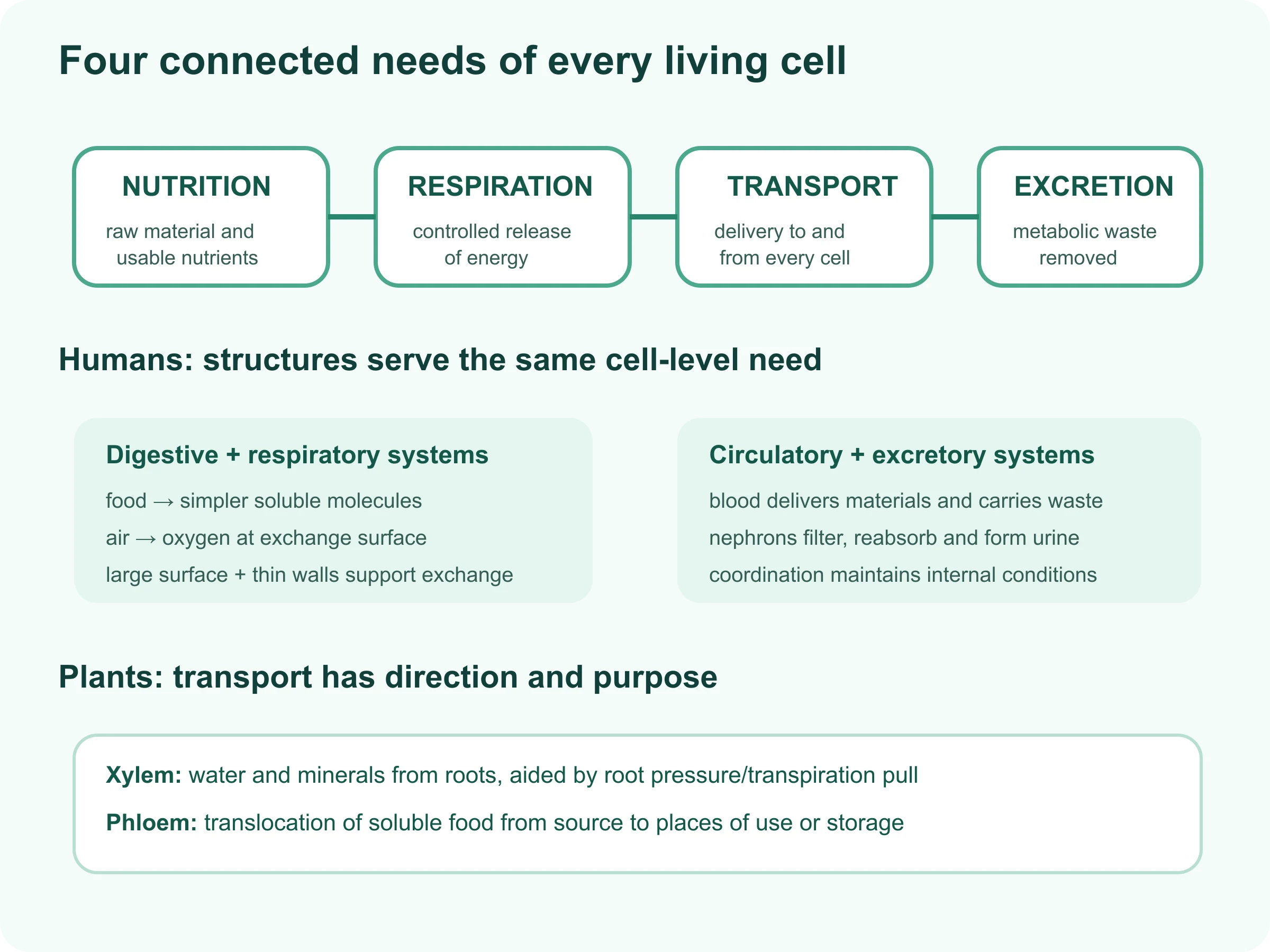
The connection is the cell. Every living cell needs usable material and energy, must exchange substances with its surroundings, and must prevent harmful wastes from accumulating. In a small organism, diffusion may cover short distances. In a large multicellular organism, specialised surfaces, tubes, fluids and organs make the same cell-level work possible at scale.
What makes a process a life-maintenance process?
Movement alone is not a reliable sign of life: a machine can move and a sleeping person may appear still. Maintenance processes continue even when there is no obvious external activity. Molecules are broken down and built, gradients are maintained, materials are transported and wastes are handled. This continuous organisation requires energy.
Nutrition: obtaining and using raw material
Autotrophic nutrition
Green plants use carbon dioxide and water to form carbohydrates in the presence of light and chlorophyll, releasing oxygen as a product in the familiar school-level equation. The process is not “plants eating sunlight.” Light supplies energy; carbon dioxide and water supply matter.
Stomata support gas exchange, while guard cells regulate their opening. Water reaches leaves through transport tissue, and carbon dioxide diffuses into the leaf. When interpreting a photosynthesis experiment, separate the condition changed, the observation made and the conclusion supported. A covered part of a leaf or a destarched plant is included to test a specific requirement, not as decoration.
Heterotrophic nutrition
Animals and many other organisms depend directly or indirectly on food made by autotrophs. In human digestion, ingestion is followed by breakdown, absorption, assimilation and egestion. Enzymes work on particular kinds of food under suitable conditions; they are not interchangeable liquids with the same job.
| Region | Main contribution | Reasoning point |
|---|---|---|
| Mouth | Mechanical breakdown; saliva begins digestion of starch | Chewing increases surface area |
| Stomach | Acidic environment, protein digestion and mixing | Mucus helps protect the lining |
| Small intestine | Completes much digestion and absorbs nutrients | Villi provide large absorptive surface |
| Large intestine | Absorbs remaining water and forms faecal matter | Egestion is not the same as excretion |
Bile helps create conditions and emulsify fats; it is not itself a digestive enzyme. Pancreatic and intestinal secretions act on major food components. Learn the pathway by following one food molecule instead of memorising an organ list.
Respiration: releasing usable energy
Breathing and respiration are related but not identical. Breathing exchanges gases with the environment. Cellular respiration releases energy through enzyme-controlled reactions inside cells. Oxygen supports efficient aerobic breakdown, while anaerobic pathways yield different products and less energy in the simplified Class 10 comparison.
| Condition | Broad pathway | Typical products in school examples |
|---|---|---|
| Oxygen available | Aerobic respiration | Carbon dioxide, water and a larger energy release |
| Yeast without oxygen | Anaerobic respiration | Alcohol, carbon dioxide and less energy |
| Muscle cells during oxygen shortage | Anaerobic pathway | Lactic acid and less energy |
Do not write that muscles “stop respiration” during vigorous activity. The issue is that oxygen delivery may not fully match demand, so an anaerobic route contributes. Later oxygen availability supports recovery processes.
Why respiratory surfaces are designed for exchange
Efficient gas exchange benefits from a large surface area, thin and moist boundary, and a mechanism that maintains concentration differences. Alveoli provide extensive surface and close blood supply. Ventilation renews air; circulation carries gases onward. Each feature answers a transport problem.
Transport in human beings
Diffusion is too slow to serve every cell across a large body. Blood acts as a transport medium, the heart maintains flow, and vessels provide routes. Plasma carries dissolved materials; red blood cells carry oxygen through haemoglobin; platelets assist clotting; white blood cells contribute to defence.
Heart and double circulation
The right and left sides help keep oxygen-poor and oxygen-rich blood from mixing substantially in the normal four-chambered human heart. Pulmonary circulation connects heart and lungs; systemic circulation connects heart and body. Blood passes through the heart twice in one complete circuit, supporting separation and effective pressure for body supply.
When drawing the heart, arrows matter more than artistic beauty. Trace venae cavae → right atrium → right ventricle → pulmonary artery → lungs → pulmonary veins → left atrium → left ventricle → aorta. Notice that artery and vein names describe direction relative to the heart, not always oxygen content.
Blood vessels and lymph
Arteries generally carry blood away under higher pressure and have thicker elastic walls. Veins return blood and often use valves to prevent backflow. Capillaries provide thin exchange surfaces. Lymph participates in returning tissue fluid and transporting absorbed fats, among other roles described in the textbook.
Transport in plants
Xylem
Water and mineral ions absorbed by roots move through xylem. Transpiration from leaves can create a pull through the continuous water column, while root pressure may contribute under some conditions. Avoid describing xylem as a pump; the plant uses physical gradients and tissue structure.
Phloem
Phloem translocates soluble products of photosynthesis from sources to places of use or storage. Movement can be towards growing regions, roots, fruits or storage organs depending on source–sink relationships. Unlike the common one-direction sketch of xylem, phloem transport is described according to where food is produced and needed.
Excretion: removing metabolic waste
Excretion is removal of metabolic waste produced by cells. Egestion removes undigested food from the digestive tract; the two must not be used as synonyms. In humans, kidneys help remove nitrogenous wastes and regulate water and dissolved substances.
The nephron as a selective processing unit
- Filtration: pressure drives small substances from blood into the nephron at the filtration region.
- Selective reabsorption: useful substances and required water are taken back according to body needs.
- Tubular processing and urine formation: the remaining fluid is adjusted and carried towards collecting structures.
A good nephron answer explains both removal and selectivity. If everything filtered were lost, useful glucose, salts and large amounts of water would be wasted. The kidney's value lies in regulated handling, not simple sieving.
Excretion in plants
Plants do not possess a human-like excretory system, but they still manage wastes. Gases can diffuse through stomata and other surfaces; substances may be stored in leaves, bark or cellular structures; some materials enter resins and gums; excess water is lost through transpiration. Use only examples supported by the prescribed material.
Four diagrams worth learning through labels and flow
- Human alimentary canal: follow food and name where major actions occur.
- Human respiratory system/alveolus: connect ventilation with diffusion and blood transport.
- Human heart: use arrows to prove the pathway and separation.
- Nephron: show filtration, reabsorption and collection along a meaningful route.
Draw each from a blank page, then explain the diagram aloud without using its labels as a script. If you cannot explain why a structure is shaped or located as shown, the picture has not yet become understanding.
High-frequency conceptual confusions
| Confusion | Correct distinction |
|---|---|
| Breathing = respiration | Breathing is gas movement; respiration is cellular energy release |
| Artery = oxygenated | Artery means away from heart; pulmonary artery is a key exception to oxygen-rich assumption |
| Excretion = egestion | Metabolic waste removal differs from undigested food removal |
| Plants do not respire | Plant cells respire continuously; photosynthesis has different requirements |
| Xylem and phloem do the same job | They transport different material through different mechanisms and source relationships |
How to answer competency-based Life Processes questions
Trace the pathway. If the case changes one organ, vessel, surface or environmental condition, ask which material can no longer enter, leave or reach its destination. In an experiment, identify control, observation and inference. In a diagram, follow arrows and labels before reading the options. The unfamiliar story usually sits on a familiar transport relationship.
A seven-day study plan
- Autotrophic nutrition and photosynthesis activity reasoning.
- Human digestion: pathway, secretions and absorption.
- Aerobic/anaerobic respiration and gas exchange.
- Heart, vessels and circulation diagram practice.
- Xylem, transpiration and phloem translocation.
- Kidney, nephron and plant waste management.
- Mixed questions, blank-page diagrams and an error log.
Board preparation without overclaiming
These concepts are central to the usual Class 10 Life Processes chapter, but students should verify the latest prescribed content for their CBSE or RBSE session. Study textbook activities and diagrams, because application questions often transform them into changed-condition cases. Do not rely on a promise that a fixed list of questions will repeat.
Useful next resources
Use the Class 10 Science Notes hub for available notes and textbook access. Build application skill with the competency-question guide, and use the active NCERT reading method when studying the official chapter.
Frequently asked questions
Why do multicellular organisms need transport systems?
Because most cells are not directly exposed to the environment and diffusion over large distances is too slow for their continuing needs.
Do plants respire only at night?
No. Plant cells respire continuously. Photosynthesis requires suitable light, while respiration supplies usable energy to living cells.
Why are alveoli numerous?
Their large combined surface, thin moist walls and close capillary supply support rapid gas exchange.
What is the simplest way to revise Life Processes?
Trace four flows from memory: food, oxygen/carbon dioxide, blood/material transport and filtrate/urine. Then redraw the major diagrams and solve changed-condition questions.