
A student can balance ten equations correctly and still lose marks when a question asks, “What would you observe?” Another can recognise a displacement reaction but cannot explain why the blue solution changes. Chemical Reactions and Equations becomes scoring only when symbols, evidence and reasoning are learned together.
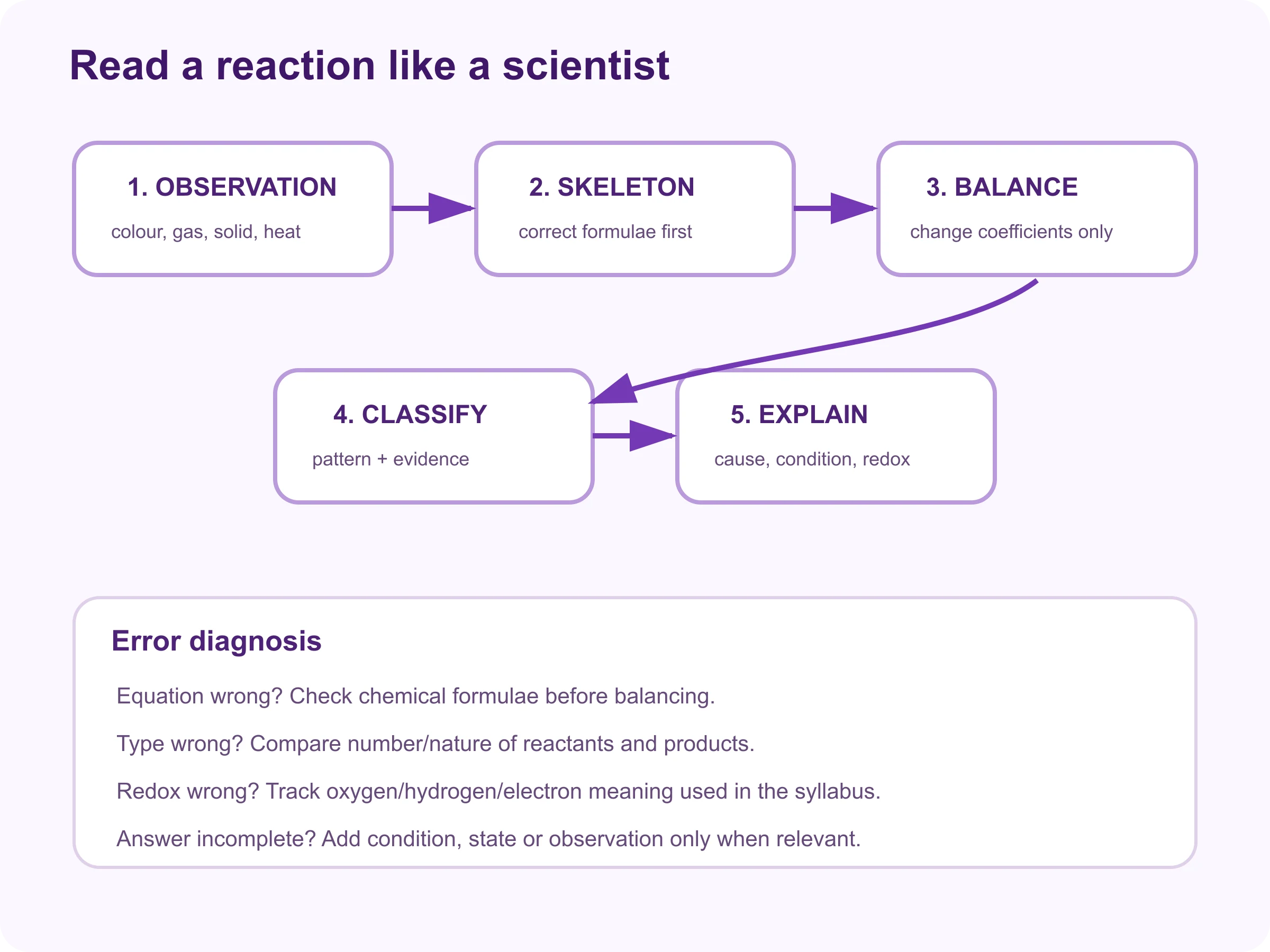
This set is not a prediction list. It is a ladder: begin with visible change, write correct formulae, conserve atoms, identify the pattern and explain what the equation means. Attempt every question before opening its explanation.
Part A: observations and chemical change
1. A magnesium ribbon is cleaned before burning. Why?
Answer: Magnesium ribbon can carry a surface layer of magnesium oxide that interferes with direct contact between the metal and oxygen. Cleaning exposes fresh magnesium so it burns more readily. The burning metal gives a bright white light and forms white magnesium oxide.
2. State two observations when an iron nail is kept in copper sulphate solution.
Answer: A brownish copper deposit forms on the nail and the blue colour of copper sulphate solution changes towards the colour associated with iron(II) sulphate. Iron, being more reactive, displaces copper: Fe + CuSO4 → FeSO4 + Cu.
3. Is melting ice a chemical reaction because its appearance changes?
Answer: No. The substance remains water and can reverse by freezing under suitable conditions. A change in appearance or state alone does not prove formation of a new substance.
4. Why is gas evolution useful evidence but not a complete conclusion by itself?
Answer: Bubbles may indicate that a gas is produced, but boiling or trapped air can also form bubbles. Identify the reactants, conditions and, where required, a test or other evidence before concluding which chemical change occurred.
Part B: write and balance
5. Balance: Al + O2 → Al2O3
Answer: 4Al + 3O2 → 2Al2O3. Start with the compound containing two elements, make oxygen count even on the product side, then balance aluminium. Do not change subscripts because that changes the substance.
6. Balance: Fe + H2O → Fe3O4 + H2
Answer: 3Fe + 4H2O → Fe3O4 + 4H2. Count Fe, O and H after every coefficient change.
7. A student writes Ca + O2 → CaO2 to balance oxygen. What is wrong?
Answer: The formula of calcium oxide has been changed. Balancing conserves atom count using coefficients: 2Ca + O2 → 2CaO. Subscripts belong to the identity of the substance.
8. Translate and balance: hydrogen combines with nitrogen to form ammonia.
Answer: N2 + 3H2 → 2NH3. Writing the correct formula of ammonia must happen before balancing.
Part C: classify through pattern
9. Classify CaO + H2O → Ca(OH)2.
Answer: It is a combination reaction because two reactants form one product. It is also exothermic in the familiar slaking-of-lime example because heat is released. A reaction can be described by more than one meaningful feature.
10. Classify 2AgCl → 2Ag + Cl2 in sunlight.
Answer: It is a photochemical decomposition reaction: one compound breaks into simpler substances using light energy. The condition “sunlight” is essential to the explanation.
11. Why is Zn + CuSO4 → ZnSO4 + Cu a displacement reaction?
Answer: Zinc is more reactive than copper and replaces copper from its salt solution. The reaction is not classified from arrow shape alone; relative reactivity explains why it proceeds.
12. What is the evidence and product pattern in Na2SO4 + BaCl2 → BaSO4 + 2NaCl?
Answer: Ions exchange partners, so it is a double displacement reaction. Insoluble barium sulphate forms as a white precipitate, supplying visible evidence.
Part D: oxidation and reduction
13. In CuO + H2 → Cu + H2O, identify oxidation and reduction.
Answer: Hydrogen gains oxygen to form water, so hydrogen is oxidised in the oxygen-based school definition. Copper(II) oxide loses oxygen to form copper, so it is reduced. Both processes occur together.
14. Why can oxidation and reduction not occur independently in a redox reaction?
Answer: The transfer must be balanced: when one species loses electrons or gains oxygen in the applicable description, another species accepts electrons or loses oxygen. Track both species in the actual equation.
15. A substance gains hydrogen. How is it described in the elementary oxygen/hydrogen definition?
Answer: Gain of hydrogen is described as reduction. Always attach the definition to the named substance rather than labelling an entire equation with one word.
Part E: corrosion and rancidity
16. Why does painting an iron gate reduce rusting?
Answer: Paint creates a barrier that limits contact of iron with oxygen and moisture, conditions involved in rust formation. If the coating is damaged, exposed iron can again corrode.
17. How does galvanisation protect iron?
Answer: A zinc coating separates iron from the environment and provides protective behaviour associated with zinc. State the coating and purpose, not only “it prevents rust.”
18. Why are some food packets flushed with nitrogen?
Answer: Nitrogen reduces contact with oxygen and therefore slows oxidative rancidity in susceptible fats and oils. Refrigeration, airtight storage and antioxidants are other context-dependent methods.
Part F: competency and case questions
19. Two beakers contain zinc sulphate and copper sulphate. An iron nail is placed in each. Predict where a visible displacement is expected.
Answer: Iron cannot displace more reactive zinc from zinc sulphate, but it can displace less reactive copper from copper sulphate. The second beaker should show copper deposition and solution change. The prediction follows the reactivity series.
20. A sealed transparent container holds a reaction mixture. Its total mass is measured before and after reaction and remains unchanged. What principle is illustrated?
Answer: Conservation of mass in a closed system. Atoms rearrange into new substances; they are not created or destroyed in the chemical reaction. A balanced equation represents this conservation.
21. A white solid turns grey in sunlight. Which questions should you ask before classifying the reaction?
Answer: Identify the substance, products and role of light. If a light-sensitive compound such as silver chloride decomposes into simpler substances, classify it as photochemical decomposition and connect the colour change to product formation.
22. A reaction makes the test tube warm. Is “exothermic” enough as the complete answer?
Answer: It identifies energy behaviour, but the question may also require equation, products, observation or structural type. Read the command word. “Classify” and “explain the observation” demand different responses.
23. A student sees no reaction between a metal and salt solution. Give two scientific possibilities.
Answer: The metal may not be reactive enough to displace the metal ion, or experimental factors such as an unclean surface, unsuitable concentration or incorrect materials may interfere. Use the supplied evidence before choosing.
24. Design a simple evidence table for any laboratory reaction.
Answer: Use columns for reactants, condition, initial appearance, final observation, product/equation and inference. This prevents the common mistake of writing a reaction type without recording what was actually seen.
Part G: assertion–reason practice
25. Assertion: A balanced equation follows conservation of mass. Reason: Coefficients make the number of each kind of atom equal on both sides.
Answer: Both statements are true, and the reason explains the assertion. Coefficients represent relative numbers of reacting particles without changing chemical identities.
26. Assertion: Every decomposition reaction requires heat. Reason: Decomposition breaks one compound into simpler substances.
Answer: The assertion is false because decomposition may be driven by heat, light or electricity in standard examples. The reason is a correct broad description but does not support the false absolute claim.
27. Assertion: A less reactive metal can displace a more reactive metal from its salt. Reason: Displacement depends on relative reactivity.
Answer: The assertion is false; the reason is true. A more reactive metal displaces a less reactive metal under suitable conditions.
A balancing method that survives difficult equations
- Write correct formulae and the skeleton equation.
- Count atoms in a small table.
- Begin with an element in the most complex compound or appearing in fewer places.
- Change coefficients, never subscripts.
- Leave free hydrogen and oxygen towards the end when helpful.
- Reduce to the smallest suitable whole numbers and recount every atom.
How to review wrong answers
| Error | Diagnostic question | Repair |
|---|---|---|
| Formula error | Did I know the actual compounds? | Revise ions/valency and names before balancing |
| Balancing error | Did I change a subscript? | Use atom counts and coefficients only |
| Classification error | Did I examine reactants/products and conditions? | Match the structural pattern and evidence |
| Observation error | Did I confuse inference with what is visible? | Record colour, gas, solid or temperature separately |
| Redox error | Did I track both species? | Write what is gained/lost by each |
Board-focused practice without prediction claims
CBSE and RBSE students should confirm their current syllabus and use prescribed textbook activities, equations and official paper directions. Practise direct, observation-based and unfamiliar-context questions. This set strengthens the process but does not guarantee examination questions or marks.
Continue the chapter
First read the complete Chemical Reactions and Equations concept guide. Use the Science Notes hub for available notes and textbook links, then review mistakes using the test-analysis method.
Frequently asked questions
Should I balance by changing subscripts?
No. Subscripts define the substance. Change coefficients placed before formulae.
Can a reaction have more than one description?
Yes. A reaction may be combination and exothermic, or displacement and redox, because the labels describe different features.
How many equations should I practise daily?
Use a small mixed set you can check carefully. Five equations with error analysis can teach more than twenty copied balances.
Where should I write state symbols and conditions?
Use them when required by the question or prescribed equation. Conditions are commonly shown near the reaction arrow; state symbols follow formulae.