
Many students revise by returning to the first page and reading until the chapter feels familiar. Familiarity is comforting, but an examination does not ask whether a page looks familiar. It asks whether you can retrieve, choose and use knowledge without the page in front of you.
A revision system must therefore do four jobs: bring information back, reveal weakness, repair errors and return before forgetting becomes complete. The system below is not a rigid calendar. It is a cycle that can be adjusted for CBSE, RBSE, school examinations and different starting levels.
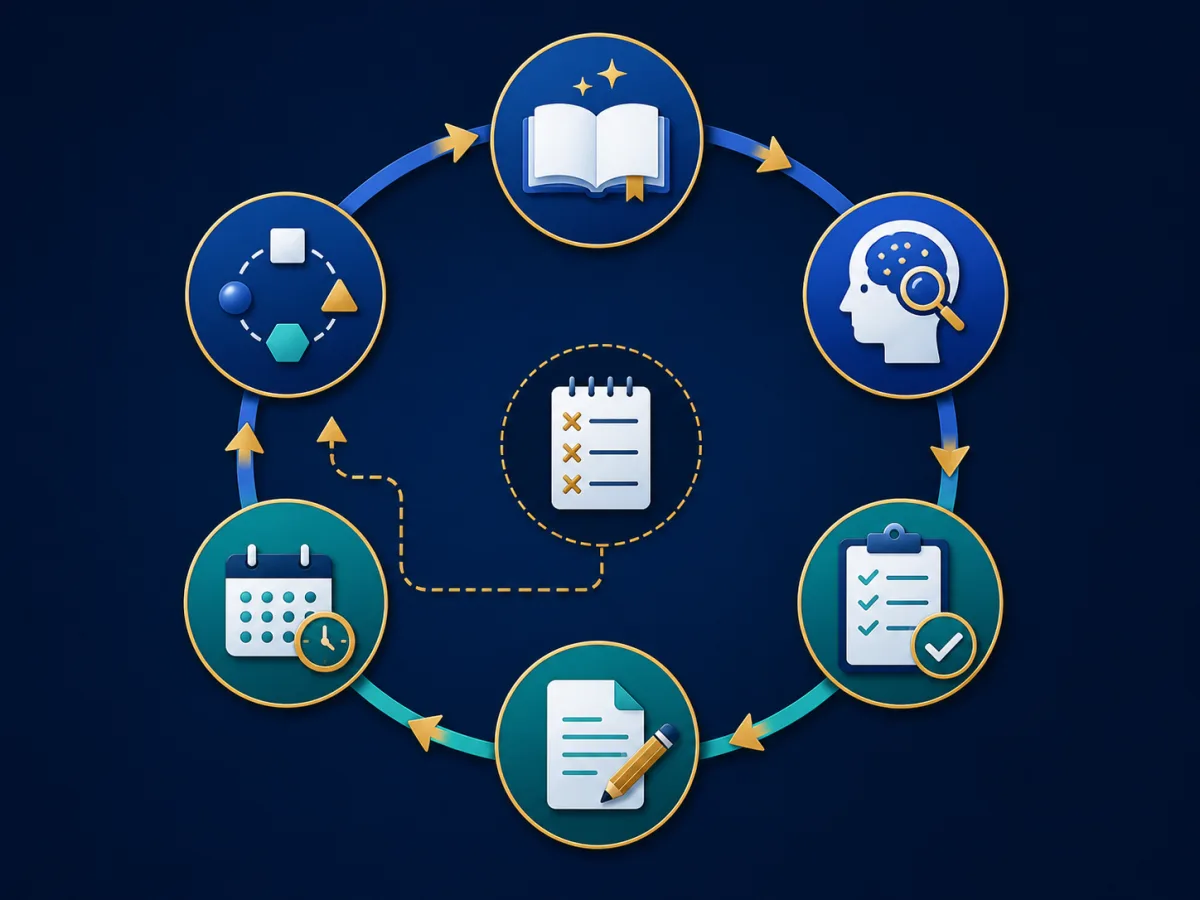
The difference between review and retrieval
Review puts information in front of you. Retrieval asks your mind to produce it. Both have a place, but retrieval provides stronger evidence. After reading a section, close the book and write what you remember. Draw the process, solve the formula, list causes, reconstruct the timeline or answer a question. The struggle is not a sign that revision failed; it is the part that makes revision useful.
| Weak revision | Stronger replacement | Evidence produced |
|---|---|---|
| Highlighting again | Turn headings into closed-book questions | What you can actually recall |
| Watching the same lecture | Explain the concept, then use video for the gap | Exact point of confusion |
| Reading solved Maths examples | Solve a mixed set without cues | Independent method selection |
| Collecting sample papers | Attempt and analyse one timed paper | Accuracy, speed and error pattern |
A flexible spacing rhythm
After first learning, revisit the chapter briefly the next day. Return after roughly a week, then after two to three weeks, and later through mixed tests. These intervals are starting points, not magic numbers. A chapter that repeatedly fails needs an earlier return; a secure chapter can wait longer.
Spacing works only when each return requires thought. Ten minutes of honest recall may be more valuable than forty minutes of passive rereading.
Build one chapter revision sheet
Do not rewrite the textbook. Compress only what helps reconstruction: core idea, important terms, equations or formulas, diagrams, comparisons, common traps and two questions you previously got wrong. The sheet should act like a doorway into the chapter, not a miniature replacement for it.
The error log that changes marks
Write four things: the question or topic; your incorrect response; why it happened; and the correct decision rule. “Careless mistake” is too vague. Was a negative sign skipped? Was the command word misread? Was a Biology label reversed? Did you know the formula but fail to convert units?
Add a retest date. An error copied into a notebook but never tested again becomes a museum exhibit. The purpose is to stop recurrence.
Use subject-specific retrieval
Science
Recall diagrams, reactions, conditions, observations, formula relationships and cause-effect explanations. Mix direct and competency-based questions.
Mathematics
Practise mixed problems so the chapter name does not reveal the method. Re-solve wrong questions after a delay and maintain a short list of decision triggers.
Social Science
Use blank-page recall, timelines, maps, comparison tables and cause-consequence chains. Then practise answers with clear points and evidence.
Languages
Retrieve writing formats, practise grammar in sentences, recall textual evidence and write under time. Reading summaries alone cannot train expression.
Three levels of testing
- Micro test: five minutes after a study block.
- Chapter or unit test: checks delayed retrieval and application.
- Full paper: checks selection, stamina, sequence and time.
Do not begin with endless full papers when concepts remain broken. But do not wait until the final week either. Testing should grow as syllabus coverage grows.
The weekly revision architecture
Reserve short daily recall for recent topics. Use two or three longer blocks for weak chapters. Take one mixed weekly test and analyse it the same day or next morning. On Sunday, schedule returns based on evidence—not on which subject you like most.
A simple tracker can contain chapter, last tested date, score or confidence evidence, major error and next review. Avoid complicated colour systems that take more time to maintain than to use.
What to do when the syllabus is incomplete
Revision and completion can run together. Keep current learning moving while revisiting previously completed chapters in short cycles. If you postpone all revision until “the syllabus is finished,” early chapters may become almost new by the time you return.
The final-month transition
As exams approach, move from chapter-isolated recall toward mixed papers and rapid error repair. Keep compact resources: formula pages, reaction lists, diagrams, maps, formats and the error log. Reduce new sources. Protect sleep because retrieval, reading accuracy and calculation control suffer when the mind is exhausted.
Build a revision calendar that can adapt
Start with fixed commitments: school, travel, meals, sleep and essential responsibilities. Place two or three high-attention blocks in the week for difficult chapters, then add short retrieval sessions. Leave buffer time. A calendar packed to 100% capacity breaks the first time school assigns a project.
Schedule outcomes, not vague hours. “Retrieve Life Processes diagram and answer five questions” is easier to start and measure than “revise Biology.” At the end of each week, move only essential unfinished work.
The traffic-light method—with evidence
Green should mean a chapter passed a delayed test, amber means partial accuracy or weak application, and red means the central concept is unavailable. Do not colour by mood. Record the date and evidence so a chapter cannot remain green simply because it was once read.
Interleaving: when to mix chapters
During first learning, focused chapter practice is useful. Once methods are understood, mix related question types. Mathematics students must learn to choose a method when the exercise heading no longer gives it away. Science students should distinguish similar reactions, processes or formula situations. Mixing feels slower but improves selection.
How to revise a large chapter in layers
- Reconstruct the chapter map.
- Test high-value definitions and relationships.
- Redraw diagrams or derive formulas.
- Solve representative direct questions.
- Attempt application and mixed questions.
- Repair only the failed layer.
This prevents rereading an entire chapter because one small area is weak.
Revision for school days
Use a short recall session before beginning new homework, then one main study block and a closing five-minute review. The next morning, try a few prompts during available time. Continuity matters more than completing every subject nightly.
Revision for holidays
Longer days invite overloaded plans. Use two deep blocks separated by rest, one test or correction block and lighter recall. Protect movement, meals and sleep. Six planned hours with no recovery can produce less learning than three focused blocks.
How to create retrieval questions
Turn headings into questions, ask “why” after each process, hide labels on diagrams, remove one step from a solution, and predict what changes when a condition changes. Good prompts require reconstruction, not yes/no recognition.
The difference between an error list and an error system
A list remembers failures. A system schedules repair. Every entry should produce an action: relearn one concept, solve a targeted set, rewrite an explanation or add a checking rule. Then it needs a retest and a status. Close entries only when the correction survives without help.
Sample revision week
| Day | Deep block | Retrieval block |
|---|---|---|
| Monday | Weak Science concept | Last week’s equations |
| Tuesday | Mixed Mathematics set | SST timeline |
| Wednesday | Language writing | Science diagrams |
| Thursday | Amber SST chapter | Maths error log |
| Friday | Science applications | Writing formats |
| Saturday | Timed mixed test | Immediate reflection |
| Sunday | Test correction | Schedule next returns |
What to do after a weak revision test
Do not automatically restart the whole chapter. Identify whether recall, concept, application, expression or time failed. Repair that layer and take a parallel test. A weak result is useful when it narrows the next action.
Prevent revision burnout
Alternate cognitively different tasks, take real breaks and keep daily goals finite. If the plan repeatedly requires late nights, it is oversized. Students are not machines, and rest is not a reward for finishing an impossible syllabus.
How parents can read the revision tracker
Ask what evidence changed rather than how many hours were spent. A chapter retested, an error removed and a timed section completed are meaningful signals. Use the tracker to offer support, not surveillance.
How to know revision is working
- You can explain without prompts.
- You select the method in mixed questions.
- Your repeated-error count falls.
- Your timed-paper completion improves.
- Your answers become more precise, not merely longer.
- A chapter remains available after a gap.
Revision is not the number of times your eyes cross a page. It is the number of times your mind successfully rebuilds and uses what the page taught.
Frequently asked questions
How many subjects should I revise daily?
There is no universal number. Many students benefit from one main subject, one shorter secondary task and brief recall, while maintaining frequent Maths and language contact.
Should I make flashcards for everything?
No. Use them for compact facts or prompts. Processes, reasoning, numericals and answer writing need richer practice.
What if I fail the same question again?
Return to the underlying concept, identify the decision you missed, solve a simpler example and then retry the original type after a delay.