
The checked answer sheet is often treated like a final judgment. Students look at the number, compare it, feel proud or disappointed, and put the paper away. But the number is the least detailed part of the feedback. The paper contains a map of where marks left—and whether the same marks will leave again.
A test becomes valuable only when it changes the next week of preparation. Analysis is not copying solutions. It is finding the cause of each loss and prescribing the correct repair.
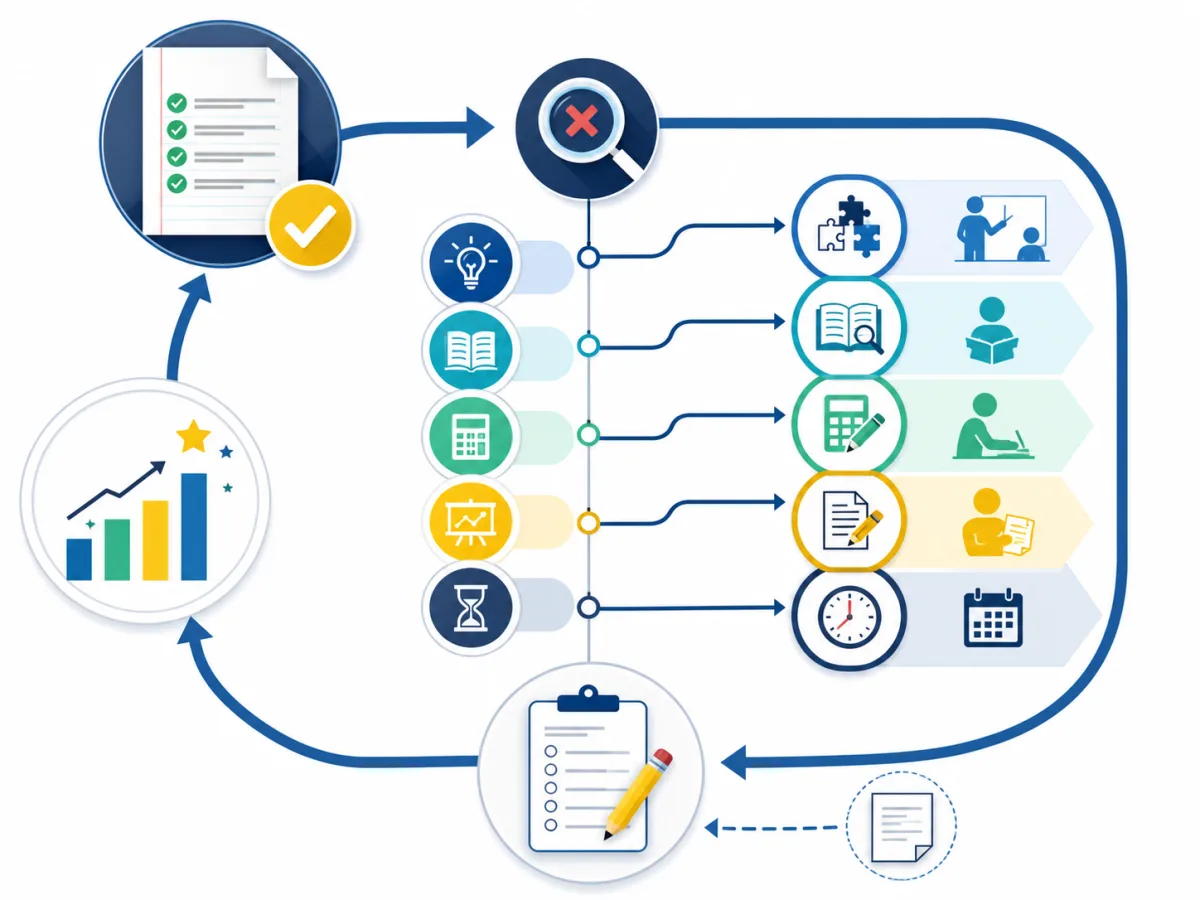
Begin without attacking yourself
Separate identity from evidence. “I am careless” is a label. “I skipped units in three numericals” is evidence. Labels feel permanent; evidence can be corrected. Wait until strong emotion settles, then inspect the paper like a coach.
The six error families
| Error | Evidence | Repair |
|---|---|---|
| Concept | Principle, fact or method not understood | Relearn, solve basic examples, retest |
| Retrieval | Knew it before but could not produce it | Spaced closed-book recall |
| Question reading | Missed command, condition or subpart | Underline demand; restate task briefly |
| Procedure/calculation | Correct idea, broken step or arithmetic | Targeted drills and checking rule |
| Presentation | Incomplete points, labels, units or reasoning | Rewrite using marking evidence |
| Time strategy | Known answers left or rushed | Timed sections and checkpoints |
Recover the marks mathematically
For every lost mark, assign an error family. Total them. A student with 12 marks lost to concept gaps needs different work from one losing 12 marks to unfinished questions. This “recoverable marks” view prevents random study.
Read teacher feedback precisely
A tick does not always mean perfect, and a cross does not explain the cause. Look for underlining, missing labels, question marks and comments. If feedback is unclear, ask respectfully what evidence was expected. Compare with the prescribed text or official marking scheme when available.
Create an error log that leads to action
Use columns for date, subject, question type, error cause, correct principle, repair task and retest date. Keep entries short. “Revise Science” is not a repair task; “explain displacement reaction and solve five identification questions” is.
Rewrite selectively
Rewrite when the answer structure was incomplete, reasoning unclear or keywords missing. Re-solve when method selection or calculation failed. Redraw when a diagram was inaccurate. Relearn when the concept itself was absent. One punishment—copying every answer three times—cannot cure six different problems.
Analyse subject patterns
Science
Check command words, scientific terminology, equations, conditions, observations, diagrams, formula use and units.
Mathematics
Trace the first incorrect step. Separate selection of method from execution. Note sign, substitution and copying errors.
Social Science
Check whether answers contain distinct relevant points, cause-effect reasoning, dates or examples where needed, and complete map work.
Languages
Separate comprehension, textual knowledge, grammar, format, expression, spelling and time. Improvement needs written practice and feedback.
Time analysis needs a timeline
Recall roughly when each section was reached. Did one difficult question consume too long? Were easy subparts left? Did you reserve review time? Practise with section checkpoints rather than merely trying to “write faster.”
The 48-hour correction cycle
- Classify every lost mark.
- Choose the two highest-impact causes.
- Repair the underlying concept or habit.
- Redo selected questions without solutions.
- Attempt a parallel question after a gap.
- Record whether the error returned.
Analyse questions you got right too
A correct answer may come from solid understanding, partial guessing or a remembered pattern that will fail when wording changes. Mark answers you were uncertain about even if they received full marks. Retest them in a changed context. This prevents lucky correctness from hiding fragile learning.
Separate preparation failure from performance failure
If you never learned the concept, the repair belongs in preparation. If you knew it but misread, rushed or froze, the repair belongs in performance. Both matter. Studying more content cannot automatically fix paper sequence, and speed drills cannot replace missing concepts.
Build an error heat map
Across three papers, count errors by subject, chapter, question type and cause. One test may be unusual; repeated patterns are stronger evidence. A heat map can reveal that marks are not spread randomly—for example, numericals are accurate but explanations repeatedly miss the “why.”
How to review a Science paper
For Chemistry, check formulae, balancing, state or condition where relevant, observations and explanations. For Physics, inspect relation selection, units, conversion, signs and final interpretation. For Biology, check terminology, sequence, labels and structure-function reasoning. Then look across all three for command-word mistakes.
How to review Mathematics
Find the first wrong step, not merely the wrong final answer. Ask whether you misunderstood the problem, selected the wrong method, recalled a property incorrectly or executed poorly. Re-solve from a blank page. Then solve two related questions where surface details differ.
How to review Social Science
Compare each answer to the command and mark allocation. Were points distinct and relevant? Did “explain” receive causes and consequences, or only a list? Was map work practised? Did time disappear in overlong early answers?
How to review languages
Separate reading comprehension, grammar, literature knowledge, writing format and expression. Record recurring spelling or grammar patterns instead of copying isolated corrections. For writing tasks, check purpose, audience, organisation and time.
The retest must be slightly different
Repeating the identical question immediately can measure memory of the correction. Use a parallel question after a delay to test whether the rule transfers. If the same type fails, simplify the task and rebuild the underlying decision.
Create checking routines for “careless” errors
| Repeated error | Checking routine |
|---|---|
| Missing units | Circle required quantity and scan every numerical result |
| Skipped subpart | Tick (a), (b), (c) only after answering |
| Wrong sign | Pause at substitution and final reasonableness check |
| Incomplete points | Plan expected evidence before writing |
| Misread command | Underline state, explain, compare or justify |
Use marks per minute carefully
Do not calculate mechanically, but keep proportionality in mind. A low-mark question should not consume the time needed for a larger section. During practice, record where you were at planned checkpoints. Adjust sequence based on evidence from multiple papers.
What a useful teacher conversation sounds like
Bring the paper and ask a focused question: “My explanation mentions the process but lost one mark—what relationship is missing?” or “I keep choosing the wrong method in this question type; which clue should I notice?” Specific questions produce teachable feedback.
What parents should avoid after a disappointing paper
Immediate comparison and punishment may make a student hide future evidence. Begin with the paper: what happened, what pattern appeared, and what is the next correction? Accountability matters, but it should produce a plan rather than fear.
A monthly improvement report
Track total score alongside attempted marks, concept-error marks, repeated-error marks, completion and one answer-quality measure. If score fluctuates but repeated errors decline and completion improves, the method may be moving in the right direction. If nothing changes, revise the strategy.
Do not overanalyse one result
A paper may contain unusual difficulty, health issues or a narrow chapter selection. Use it, but confirm conclusions across more evidence. Test analysis should create precision—not another form of anxiety.
Turn patterns into personal rules
If units repeatedly disappear, your rule becomes “circle the required unit before finalising.” If questions are misread, pause after each command word. If Biology explanations miss causal links, use “because—therefore” planning. Personal rules are strongest when linked to repeated evidence.
A low score is painful when it feels final. It becomes useful when every lost mark is converted into a decision.
Frequently asked questions
What if I disagree with the marking?
First compare the response with the question and expected evidence. Then ask the teacher calmly for clarification; do not let one disputed mark replace the larger analysis.
How many errors should I repair at once?
Prioritise one or two recurring, high-impact patterns per week while correcting urgent concept gaps.
Should parents analyse the paper?
Parents can support a calm review, but the purpose should be diagnosis and planning—not shame or comparison.