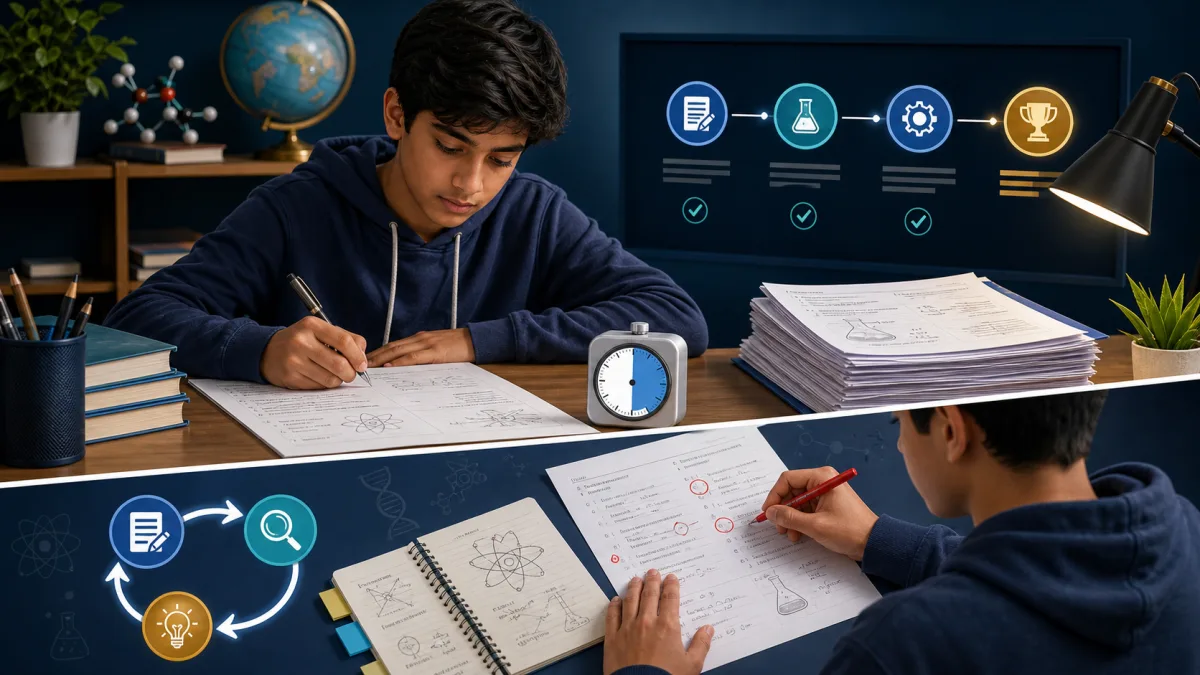

Most students treat practice tests as a way to check what they know. That is only half the purpose. Practice tests also build something that cannot be learned from a textbook ? exam temperament. The ability to think clearly under time pressure, manage anxiety, and make good decisions about which questions to attempt first. These skills only develop through repeated practice under exam-like conditions.
Chapter-Wise Tests vs Full-Length Tests
There are two types of practice tests, and both serve different purposes:
- Chapter-wise tests ? Used during the study phase, after completing each chapter. They confirm whether you have understood the chapter well enough to answer exam-style questions. If you score poorly on a chapter test, you know exactly where to go back and revise.
- Full-length / preboard tests ? Used in the final month before the exam. They simulate the actual board exam experience ? full paper, full time, no interruptions. They reveal how well you manage time across the entire paper and which sections need more attention.
How to Take a Practice Test Properly
A practice test taken casually is almost useless. Here is how to take one properly:
- Set a timer for the exact duration of the actual exam.
- Sit at a desk with no phone, no music, no interruptions.
- Attempt every question ? do not skip and come back later during practice.
- When time is up, stop ? even if you are mid-sentence.
- Check your answers carefully and note every mark lost and why.
The analysis after the test is as important as the test itself. Students who skip the analysis miss the entire point of the exercise.
Class 10 Science Practice Tests at Quanta Classes
Class 10 Science practice tests are available chapter-wise for Chemistry, Physics, and Biology ? along with major tests covering multiple chapters and preboard papers for full-syllabus practice. Tests are added regularly as new material is uploaded.
The chapter-wise structure mirrors the approach used in Quanta Classes coaching sessions ? study a chapter, practise it, confirm understanding, then move forward.
When to Start Taking Tests
Start chapter-wise tests as soon as you finish each chapter ? do not wait until you have completed the entire syllabus. By the time you reach the last chapter, you will have already tested and revised the first chapters multiple times. This distributed practice is far more effective than a last-minute cramming session.
Begin full-length preboard tests approximately six weeks before the board exam. Aim for at least two to three full-length tests before the actual exam day.
What to Do When You Score Poorly
A low score on a practice test is not a problem ? it is information. It tells you exactly where your preparation is weak. Go back to the NCERT chapter, review the relevant notes, and attempt the test again after a few days. Improvement on a retake is one of the most reliable indicators of genuine learning.
Start practising: Class 10 Practice Tests ? Class 10 PYQs ? How to Study Science for Class 10
A test is useful only when it changes your next study session
Two students can receive the same 24 out of 40 and learn completely different lessons. One checks the score, feels disappointed and closes the paper. The other sits with the paper for twenty quiet minutes and asks: Which marks were lost because I did not know the concept? Which answer did I know but fail to present? Where did I rush? That second student has turned one test into a study plan.
This matters in Science because a low mark does not always mean weak understanding. A missing unit, an unbalanced equation, an unlabeled ray diagram or an answer that ignores the command word can each cost marks for a different reason. Treating every error as “I need to study more” hides the real problem.
Choose the test that matches your stage
| Stage | Right test | What it should reveal |
|---|---|---|
| Just learned a topic | 10-15 minute concept check | Definitions, relationships and first misunderstandings |
| Finished a chapter | Chapter test with mixed question types | Recall, application, diagrams and written structure |
| Several chapters complete | Mixed-syllabus test | Whether you can identify the correct concept without a chapter heading |
| Before an examination | Timed paper in the current board pattern | Selection, pacing, stamina and final presentation |
The four-pass review
- Mark the cause, not only the answer. Use simple codes such as C for concept, R for recall, P for presentation and T for time.
- Repair the smallest missing piece. Revisit the exact paragraph, activity, diagram or worked example connected to the error.
- Rewrite without looking. Correction is not complete when the right answer merely looks familiar. Produce it from a blank page.
- Retest after a gap. Try a different question based on the same idea two or three days later. That is the check that tells you whether learning changed.
Keep one mistake log with four columns: question or concept, cause of error, corrected rule, and retest date. A short honest log is more useful than a decorative notebook that is never reopened.
CBSE and RBSE students should not practise blindly
Use the current syllabus, sample or model papers and marking guidance issued for your board and session. The science remains the same, but paper design, emphasis and instructions can differ. Do not assume that an old paper predicts what will repeat. Previous papers are evidence of how concepts have been assessed; they are not a promise of future questions.
After every test, connect the result to the Class 10 Science notes hub. If marks were lost despite knowing the chapter, use the Science answer-writing guide. This keeps practice tied to a specific next action.

No comments yet. Be the first to comment.