Class 10 Science Chapter 3 — Metals and Non-Metals Full Explanation
Metals and Non-Metals is one of the most important chapters of Class 10 Science for both CBSE and RBSE students. This chapter builds the foundation of Chemistry because almost every higher chemistry concept depends on understanding metals, non-metals, reactivity, corrosion and chemical behaviour.
Most students only memorise definitions, but the real understanding comes when you connect the chapter with practical science, daily life examples and reactions.
In this complete Quanta Classes guide, we will deeply understand:
- Physical properties of metals
- Physical properties of non-metals
- Chemical properties of metals
- Reactivity series
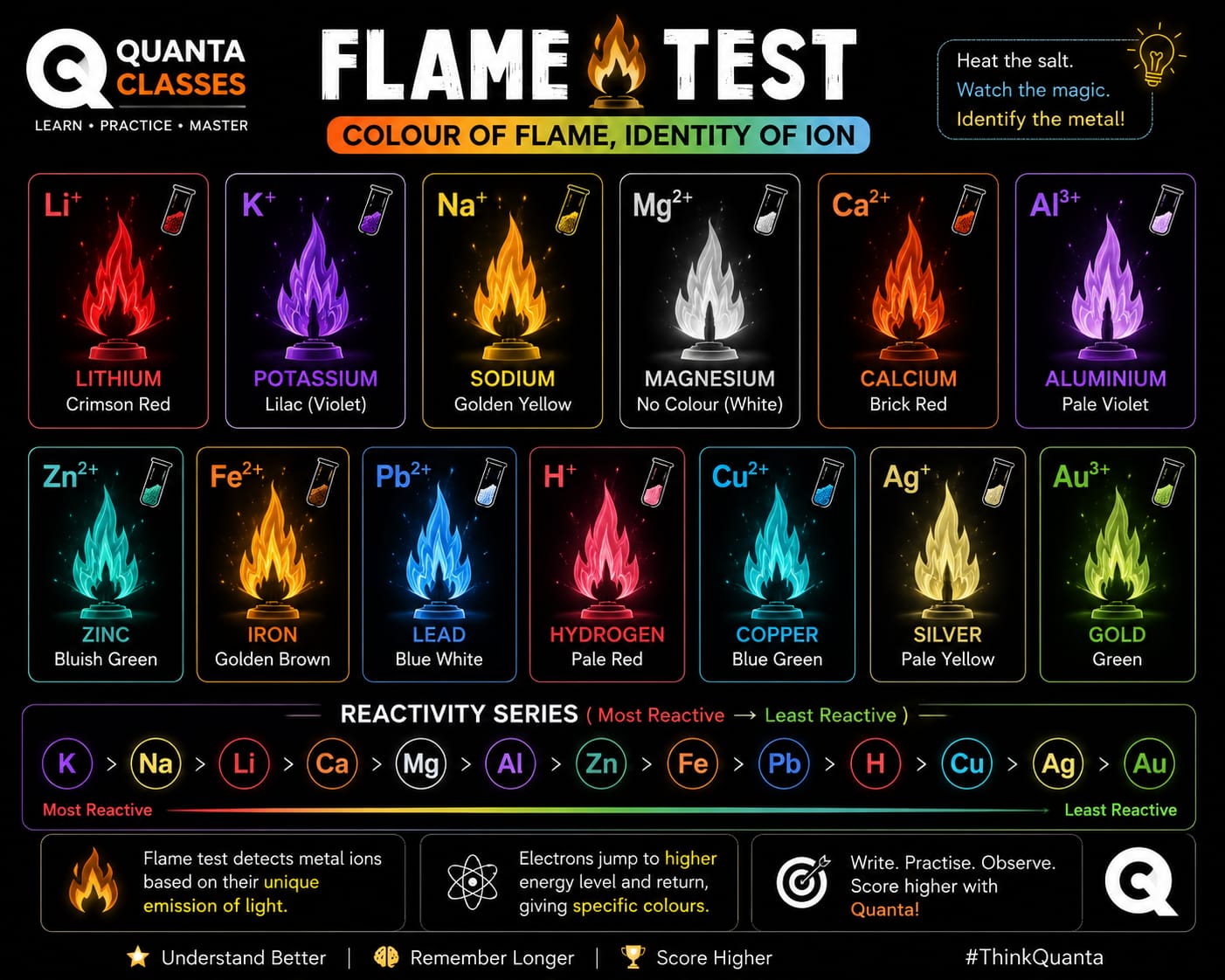
- Flame test and colour of ions
- Displacement reactions
- Corrosion and prevention
- Extraction of metals
- Uses of metals and non-metals
- Ionic compounds
- NCERT activities and board questions
What are Metals?
Metals are elements that generally lose electrons to form positive ions. They are shiny, hard and good conductors of heat and electricity.
Examples of Metals
- Iron (Fe)
- Copper (Cu)
- Gold (Au)
- Silver (Ag)
- Sodium (Na)
- Potassium (K)
- Magnesium (Mg)
- Aluminium (Al)
Physical Properties of Metals
1. Lustre
Metals have shiny surfaces known as metallic lustre.
2. Malleability
Metals can be beaten into thin sheets.
Example: Aluminium foil.
3. Ductility
Metals can be drawn into wires.
Example: Copper wires.
4. Conductivity
Metals conduct heat and electricity very well.
5. Sonority
Metals produce ringing sound when struck.
6. Hardness
Most metals are hard except sodium and potassium.
What are Non-Metals?
Non-metals are elements that generally gain electrons to form negative ions.
Examples of Non-Metals
- Oxygen
- Nitrogen
- Sulphur
- Chlorine
- Carbon
- Phosphorus
Physical Properties of Non-Metals
- Generally dull
- Not malleable
- Not ductile
- Poor conductors
- Brittle in solid state
- Non-sonorous
Important Exceptions
- Graphite conducts electricity
- Iodine is lustrous
- Diamond is extremely hard
Chemical Properties of Metals
Reaction with Oxygen
Metals react with oxygen to form metal oxides.
2Mg + O₂ → 2MgO
Magnesium burns with bright white flame.
Nature of Metal Oxides
Most metal oxides are basic in nature.
Na₂O + H₂O → 2NaOH
Amphoteric Oxides
Some oxides behave as both acids and bases.
Examples:
- Aluminium oxide
- Zinc oxide
Reaction with Water
Highly reactive metals react violently with water.
2Na + 2H₂O → 2NaOH + H₂
Hydrogen gas is released.
Reaction with Acids
Metals react with dilute acids to form salt and hydrogen gas.
Zn + 2HCl → ZnCl₂ + H₂
Reaction with Salt Solutions
More reactive metals displace less reactive metals.
Zn + CuSO₄ → ZnSO₄ + Cu
Flame Test — Colour of Flame and Identity of Ion
The flame test is an important practical chemistry method used to identify metal ions by observing flame colour.
Every metal ion produces unique colour because electrons absorb heat energy and jump to higher energy levels.
Flame Colours of Important Ions
- Lithium → Crimson Red
- Potassium → Lilac Violet
- Sodium → Golden Yellow
- Magnesium → White
- Calcium → Brick Red
- Aluminium → Pale Violet
- Zinc → Bluish Green
- Iron → Golden Brown
- Lead → Blue White
- Hydrogen → Pale Red
- Copper → Blue Green
- Silver → Pale Yellow
- Gold → Green
Scientific Explanation of Flame Test
When salts are heated:
- Electrons absorb energy
- Electrons jump to excited state
- Electrons become unstable
- They return to lower state
- Energy is released as coloured light
Different metals release different wavelengths, so different colours appear.
Reactivity Series Explained
The reactivity series arranges metals from most reactive to least reactive.
K > Na > Ca > Mg > Al > Zn > Fe > Pb > H > Cu > Ag > Au
Most Reactive Metals
- Potassium
- Sodium
- Calcium
These metals react violently with water.
Moderately Reactive Metals
- Zinc
- Iron
- Lead
Least Reactive Metals
- Copper
- Silver
- Gold
Memory Trick for Reactivity Series
Please Stop Calling Me A Zebra Instead Try Learning How Copper Saves Gold
What is Corrosion?
Corrosion is the slow destruction of metals due to reaction with moisture and oxygen.
Rusting of Iron
4Fe + 3O₂ + xH₂O → 2Fe₂O₃·xH₂O
Conditions Required for Rusting
- Oxygen
- Water or moisture
Methods to Prevent Corrosion
- Painting
- Galvanisation
- Greasing
- Electroplating
- Alloy formation
Extraction of Metals
Metals are extracted from ores.
What is an Ore?
An ore is a naturally occurring mineral from which metal can be extracted economically.
Steps of Extraction
- Concentration of ore
- Conversion into oxide
- Reduction of oxide
- Refining of metal
Extraction According to Reactivity
Highly Reactive Metals
Extracted by electrolysis.
Moderately Reactive Metals
Extracted using carbon reduction.
Low Reactive Metals
Found in free state.
Ionic Compounds
Ionic compounds are formed by transfer of electrons.
Properties of Ionic Compounds
- High melting point
- Hard and brittle
- Conduct electricity in molten state
- Generally soluble in water
Example
NaCl (Sodium Chloride)
NCERT Activities Explained
Burning Magnesium Ribbon
- Bright white flame appears
- White ash forms
- Magnesium oxide is produced
2Mg + O₂ → 2MgO
Iron Nail in Copper Sulphate
Iron displaces copper because iron is more reactive.
Fe + CuSO₄ → FeSO₄ + Cu
Sodium in Water
Sodium reacts violently and moves rapidly on water surface.
Difference Between Metals and Non-Metals
| Metals | Non-Metals |
|---|---|
| Lustrous | Dull |
| Malleable | Brittle |
| Ductile | Non-ductile |
| Good conductors | Poor conductors |
| Sonorous | Non-sonorous |
Important Board Questions
1. Why are sodium and potassium stored in kerosene?
Because they react violently with air and moisture.
2. Why does aluminium resist corrosion?
Because aluminium forms protective oxide layer.
3. Why is copper used in electrical wires?
Because copper is highly conductive and ductile.
4. Why is graphite used in electrodes?
Because graphite conducts electricity.
Real Life Applications of Metals
- Iron used in construction
- Copper used in wires
- Gold used in jewellery
- Aluminium used in aircraft
- Silver used in ornaments
Real Life Applications of Non-Metals
- Oxygen for respiration
- Nitrogen in fertilisers
- Chlorine in water purification
- Carbon in fuels
Best Tips to Score High in Exams
- Learn reactivity series daily
- Practise equations regularly
- Remember flame colours visually
- Focus on NCERT activities
- Understand concepts instead of memorising blindly
Conclusion
Metals and Non-Metals is one of the highest scoring chapters in Class 10 Science. Once students deeply understand reactivity, corrosion, flame test and extraction concepts, Chemistry becomes much easier.
The flame test especially connects Chemistry with practical science because every element shows unique colour identity.
At Quanta Classes, we focus on conceptual learning, visual understanding and board-level preparation so students can confidently solve NCERT, HOTS and practical questions.
Related: Best Class 10 Coaching · RBSE & CBSE Tuition · Best Coaching Classes Near Ganganagar